

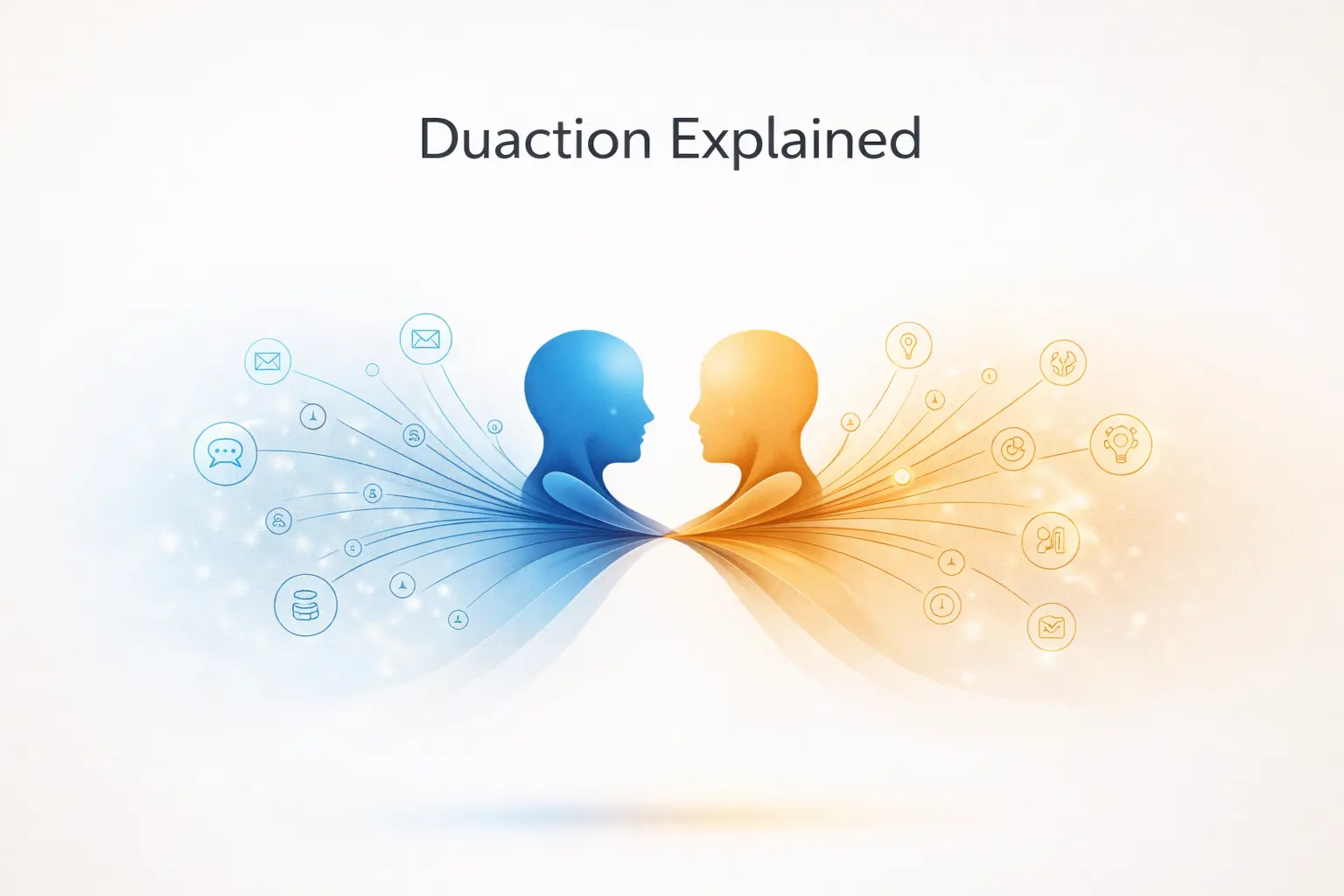
Duaction is a conceptual way of understanding human interaction where actions and responses continuously influence each other. Instead of seeing behavior as one person acting and another reacting, duaction frames interaction as a shared process shaped by mutual influence, feedback loops, and evolving patterns.
In simple terms, duaction explains why relationships are not built on single moments, but on repeated exchanges. Each action changes the context for the next response, and over time, these exchanges create meaning, expectations, and emotional tone.
Is Duaction a Real Concept or a Made-Up Word?
Duaction is not a formal dictionary entry or a clinical psychology term. It is best understood as an interpretive framework, not a scientific theory. Its value comes from how clearly it describes something people already experience: patterns of interaction that reinforce themselves.
Rather than replacing established ideas in behavioral psychology or communication theory, duaction sits alongside them. It offers a practical lens for observing how relationships evolve through everyday behavior.
Why Duaction Matters in Human Relationships
Many relationship problems are misunderstood because people focus on isolated actions. Duaction shifts attention to patterns.
It matters because it helps explain:
- Why small behaviors escalate into recurring conflict
- How trust is built through consistency, not intention alone
- Why good intentions can still lead to negative outcomes
- How communication habits shape emotional safety
When people understand duaction, blame becomes less useful than awareness. The focus moves from “Who caused this?” to “How is this pattern being maintained?”
How Duaction Works: Step by Step
Duaction unfolds through a simple but powerful cycle.
- An action occurs
A word, tone, behavior, or decision sets the interaction in motion. - A response follows
The other person reacts based on perception, emotions, and past experiences. - Feedback is created
That response influences the next action, often subtly. - A pattern forms
Repeated cycles create habits, expectations, and emotional dynamics.
Over time, these loops define the relationship more than any single event.
Duaction vs Traditional Views of Interaction
| Aspect | Traditional Interaction | Duaction Perspective |
|---|---|---|
| Focus | Individual actions | Mutual influence |
| Responsibility | One-sided | Shared |
| Timeframe | Moments | Patterns over time |
| Meaning | Fixed | Co-created |
Traditional views often ask, “Who started it?”
Duaction asks, “What keeps this going?”
Types of Duaction in Everyday Life
Emotional Duaction
Emotions expressed by one person affect the emotional state of the other. Repeated emotional exchanges shape closeness or distance.
Communicative Duaction
Tone, timing, and wording influence how messages are received and returned, shaping conversation flow.
Behavioral Duaction
Repeated actions create expectations. Support builds trust; inconsistency builds doubt.
Conflict Duaction
Defensiveness invites withdrawal, which invites more defensiveness. Duaction explains escalation cycles.
Real-World Examples of Duaction
In Romantic Relationships
One partner avoids difficult conversations. The other feels ignored and pushes harder. Avoidance increases. Both reinforce the pattern.
In Friendships
Consistent listening leads to openness. Openness leads to deeper connection. Trust compounds over time.
In the Workplace
A manager’s dismissive tone reduces employee confidence. Reduced confidence affects performance, reinforcing the manager’s perception.
In Parenting
A child’s behavior and a parent’s response shape each other continuously, forming habits on both sides.
Who Duaction Applies To (and When It Doesn’t)
Duaction is most useful for:
- Reflecting on relationships
- Improving communication
- Understanding recurring patterns
- Building empathy and awareness
Duaction is not appropriate when:
- Personal safety is at risk
- Clear boundaries are being violated
- Legal or ethical accountability is required
- Power imbalances remove real choice
Understanding duaction should never excuse harmful behavior.
Benefits of Duaction Thinking
- Encourages shared responsibility
- Reduces blame-based thinking
- Improves communication awareness
- Helps break negative cycles
- Supports emotional intelligence
By focusing on patterns, people can make small changes that create meaningful shifts.
Limitations and Risks
Duaction also has limits.
- It can feel abstract without examples
- It may lead to over-analysis
- It should not replace accountability
- It can be misused to justify harmful dynamics
A key boundary: mutual influence does not mean equal responsibility, especially where power is uneven.
Common Mistakes People Make
- Using duaction to avoid taking responsibility
- Assuming all patterns are equally shared
- Ignoring context, power, or history
- Trying to “fix” others instead of adjusting responses
Duaction works best as a mirror, not a weapon.
Practical Tools to Apply Duaction in Daily Life
Reflection Questions
- What pattern keeps repeating here?
- How does my response shape the next moment?
- What small change could shift this loop?
Pattern-Breaking Techniques
- Change tone instead of content
- Pause before responding
- Name the pattern calmly
- Adjust timing rather than intention
Communication Checklist
- Am I reacting or responding?
- Did I consider how my behavior affects the next step?
- Is this about the moment or the pattern?
Duaction Compared to Related Concepts
Duaction overlaps with several established ideas but remains distinct.
- Interaction theory focuses on meaning-making
- Feedback loops explain response cycles
- Behavioral psychology studies conditioned responses
- Systems thinking examines interconnected parts
Duaction’s strength lies in its simplicity and practical framing, not formal theory.
When Duaction Thinking Is Most Helpful
- Repeated misunderstandings
- Cyclical conflicts
- Emotional distance without clear cause
- Communication breakdowns
- Team or family dynamics
It is especially useful when the same issue keeps returning in different forms.
When Duaction Thinking Is Not Helpful
- Abuse or coercion situations
- Clear violations of boundaries
- Situations requiring authority or enforcement
- Emergencies requiring immediate action
In these cases, safety and clarity matter more than pattern analysis.
Conclusion
Duaction offers a clear lens for understanding how relationships are shaped—not by single actions, but by patterns of mutual influence. It encourages awareness, responsibility, and thoughtful change without denying accountability.
By noticing interaction loops and adjusting small behaviors, people can shift entire dynamics. Duaction doesn’t promise perfect relationships, but it offers something more realistic: a way to understand how they actually work.
FAQs
What does duaction mean?
It refers to how actions and responses mutually shape interactions over time.
Is duaction a real word?
It is a conceptual term, not a formal dictionary entry.
Is duaction scientific?
It aligns with recognized ideas in communication and behavioral psychology but is not a clinical theory.
How does duaction affect relationships?
It explains how repeated interaction patterns build trust, conflict, or distance.
Is duaction the same as interaction?
No. Duaction emphasizes shared influence and ongoing feedback, not isolated actions.
Can duaction help communication?
Yes, by helping people recognize and adjust recurring patterns.
Can duaction be harmful?
Only if misused to excuse harmful behavior or ignore power imbalances.
